
Cancer

Carcinogenesis and Neoplasia ... a Companion Site.

c-Myc

The MYC proto-oncogene encodes the transcription factor, c-Myc protein, which binds DNA to regulate transcription. c-MYC is the cellular homolog of the retroviral v-myc oncogene, which when altered by chromosomal translocation, or amplification, or when exhibiting deregulated expression, plays a significant role in mutagenesis of tumors including bladder and breast cancers. c-Myc binds with a variety of protein interactors.

The c-Myc transcription factor is a helix-loop-helix leucine zipper protein that dimerizes with an obligate partner, Max, to bind DNA sites, 5'-CACGTG-3', termed E-boxes. c-Myc also binds DNA sites that vary from this palindromic hexanucleotide canonical sequence [3]. [s]

Oncogenes: c-Fos : c-Jun : c-Myc : c-Sis : Ras : Rb : v-Fos : v-Sis : v-Myc :
Tumor Suppressor Genes: TP53
Tables  Oncogenes Proto-oncogenes  Malignant Transformation  Regulatory Proteins Sequences  Cell signaling  Cell Adhesion  Apoptosis vs Necrosis  Apoptosis 

. c-Myc Cancer Gene . Genome Biology .

Top ▲

Labels: , , , ,

| 0 Guide-Glossary

oncogenes

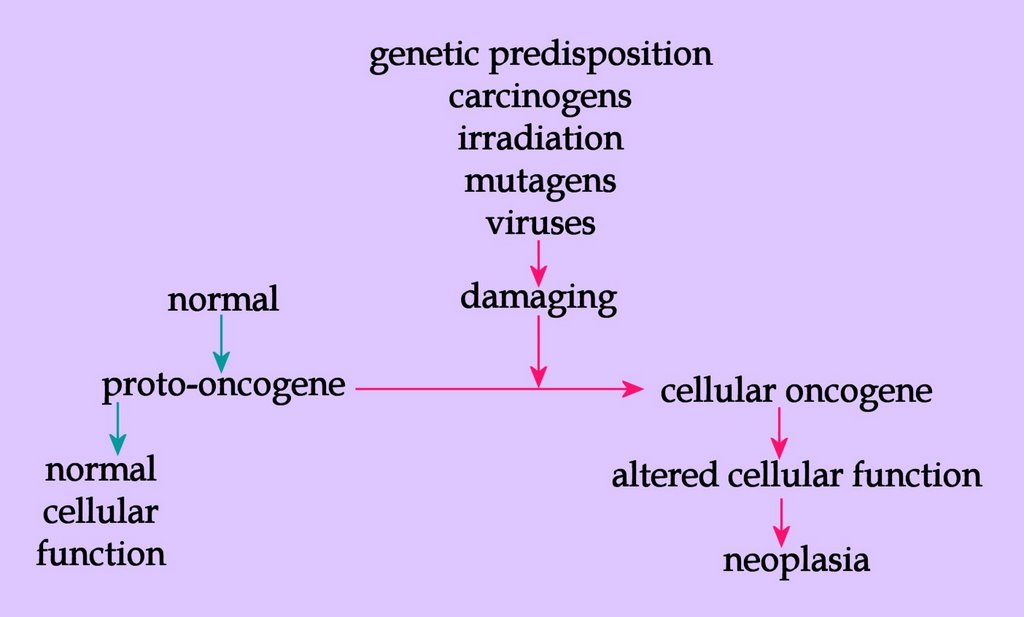
Alteration of a gene that normally controls cell growth can promote the uncontrolled growth characteristic of cancer. The normal form of the gene is termed a proto-oncogene, and the malignantly transformed gene is termed an oncogene.

Oncogenes: c-Fos : c-Jun : c-Myc : c-Sis : Ras : Rb :
Tumor Suppressor Genes: TP53

Damaged genes are passed down through the cancer cell line, and may be dominant or recessive genes:

Recessive: tumor suppressors, growth suppressors, recessive oncogenes or anti-oncogenes. Malignant transformation can result from genetic damage to genes coding for growth factors, growth factor receptors and/or proteins for signal transduction cascades.

Dominant: Proto-oncogenes participate in a variety of normal cellular functions, but have the potential to tranform into cellular oncogenes when damaged. Proto-oncogenes normally function in the various signal transduction cascades that regulate cell growth, proliferation and differentiation. Cellular proto-oncogenes resident in transforming retroviruses are designated as c- (cellular origin) as opposed to v- (retroviral origin). Oncogenes are malignantly transformed proto-oncogenes - table  Oncogenes Proto-oncogenes

14-3-3 proteins are a family of highly conserved cellular proteins that play key roles in the regulation of central physiological pathways. More than 200 14-3-3 target proteins have been identified, including proteins involved in mitogenic and cell survival signaling, cell cycle control and apoptosic cell death. Importantly, the involvement of 14-3-3 proteins in the regulation of various oncogenes and tumor suppressor genes points to a potential role in human cancer. Tzivion G, Gupta VS, Kaplun L, Balan V. 14-3-3 proteins as potential oncogenes. Semin Cancer Biol. 2006 Jun;16(3):203-13. Epub 2006 Apr 1.

Oncogenes: c-Fos : c-Jun : c-Myc : c-Sis : Ras : Rb :
Tumor Suppressor Genes: TP53
Proto-oncogene/oncogene families ● growth factor genes ● receptor tyrosine kinases ( RTKs) ● membrane ssociated non-receptor tyrosine kinases (PTKs) ● G-protein coupled receptors (GPCRs) ● Serine/Threonine Kinases ● nuclear DNA-binding/transcription factors ●

¤ Cancer ¤ carcinogenesis ¤ oncogenes ¤ proliferation ¤ p53 ¤ retroviruses ¤ Rb ¤ signaling molecules ¤ tumor suppressors ¤ tumorigenic viruses ¤ site map ¤ Tables  Oncogenes Proto-oncogenes  Malignant Transformation  Regulatory Proteins Sequences  Cell signaling  Cell Adhesion  Apoptosis vs Necrosis  Apoptosis 

▲ Top ▲

Labels: , , , , , , , , , , , ,

| 0 Guide-Glossary

. . . proliferating since 10/06/06